
Oromia Region, Ethiopia, 10th & 11th September 2017
Before coming to Ethiopia we didn’t even know that Ethiopians have a different calendar and that their New Year celebrations happen on the 10th and 11th of September (New Year’s Eve and New Year)! So we were very lucky that we found ourselves in Ethiopia at this time and even luckier that we got an invitation to celebrate this holiday with the local family.
Usually the New Year is celebrated in the family house. We were lucky to meet Kassahun on a night out, which you can learn more about from our 2nd vlog. Kassahun and his family were kind to invite us to celebrate the New Year with them, in his Mother’s house, just outside of Addis Ababa, in the Oromia Region.
It was definitely one of a kind experience, especially that we didn’t know we’ll be staying there for the night, so we didn’t have a single change of clothes or a toothbrush with us…but this didn’t matter because Kassahun’s family was so lovely that they even lent Hanna some pyjamas for the night!
Thanks to spending the New Year with this Ethiopian family, we were able to be observe and learn about their annual traditions, and we thought we would share with you what exactly happens on those two days. In case you end up like us, you’ll know what to expect!
All starts on the 10th of September (New Year’s Eve) and ends on the 11th of September (New Year):
1. Buying a sheep and a chicken

A chicken and a sheep are bought on the New Year’s Eve, as it’s a tradition to slaughter the sheep and the chicken in the early morning of New Year’s Day.
2. Bbq’ing corn
A little stove is brought into the room and corn on the cob is bbq’ed on the fire. It’s all smoky and very yummy! It’s then wrapped up in a corn leaf and given to everyone to nibble on.
3. Spreading fresh scented grass on the floor
The long grass is cut from the garden and brought into the house. Then one of the herbs is added to it to create a lovely scent and the mix is spread out on the floor of the house.
4. New Year’s Eve meal
The injeer is served together with a few pots of different dishes. There are some dishes with meat and some vegetarian. This meal is pretty much just a regular meal, as it's the New Year's Lunch that's special.
5. Coffee ceremony
A hand-made matt is brought and spread out over the grass on the floor in the living room. The matt has some decorative patterns weaved in into it and lots of fringes. Then, a small low table is brought in with the coffee cups piling up on it. There is also a special coal stove brought in and a small flat round metal plate on which the coffee beans are roasted on. Once the coffee beans are finished roasting, they’re scooped into a round pot and their smoke and smell fill the whole room. The coffee girl then lets the elders smell the coffee beans to ensure they’re properly roasted. After that the beans are ground and mixed with the water in the clay jug which is placed back on the stove. Once the coffee is boiled, it’s poured into small cups and an aromatic herb is added. Then the coffee is served, starting from the elders, and ending on everyone aged 18 and above. Under 18’s are not allowed to drink coffee!


6. Burning ‘chibo’, singing and dancing
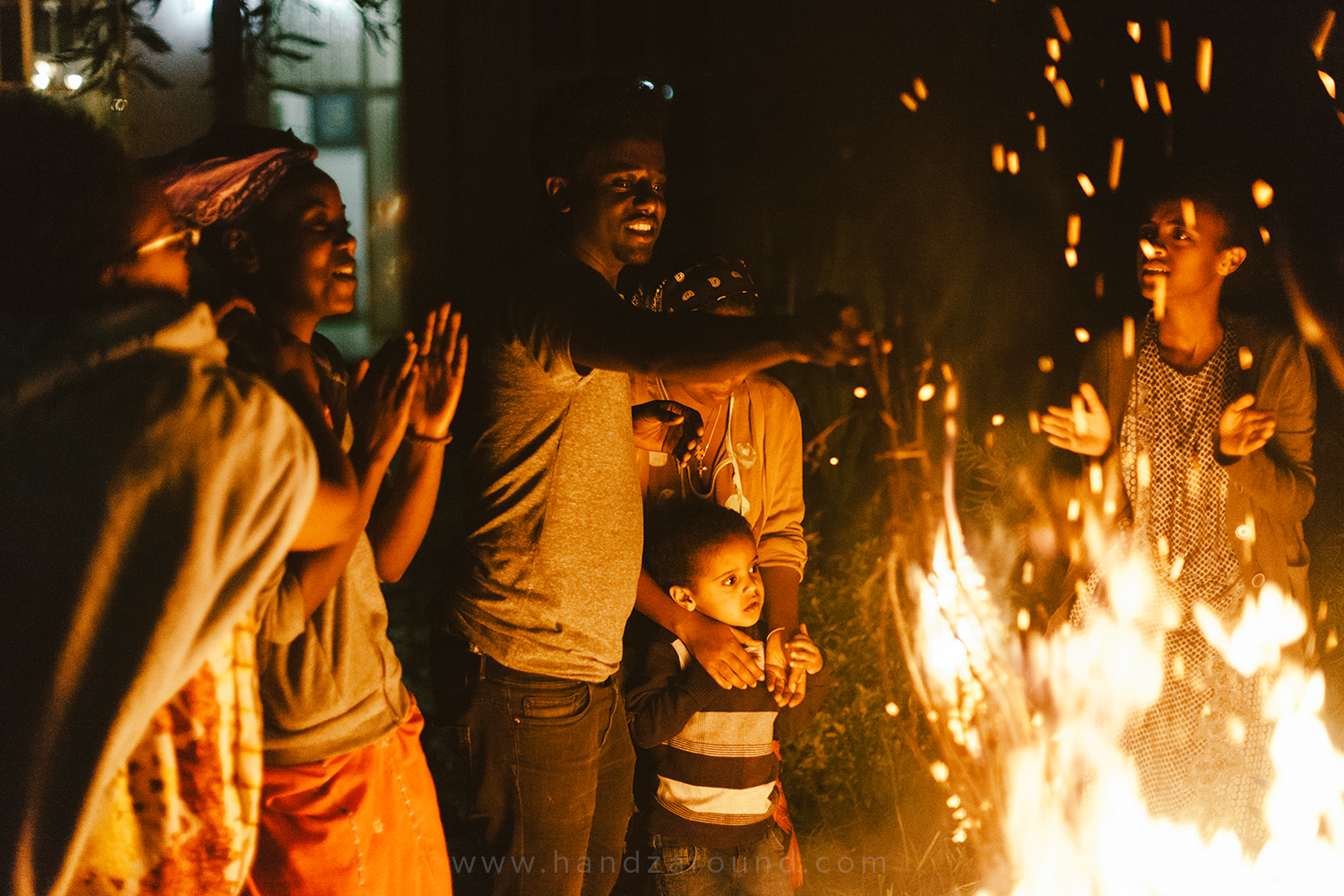
The tips of long bundles of tied up twigs and sticks are placed into the little stove’s fire, all starting in the corridor of the house. Once the bundles catch the fire, they’re quickly taken outside, to the front yard. There a small fireplace is made up from them and the dances and singing begins. The family dances in a circle around the fire and sings happy songs whilst wishing each other well for the New Year. At the end when the fire dies a little, everyone jumps three times over the pit, to leave the old year behind and welcome the New Year.
7. DRINKING Araki
A home-made liquor is served in shot glasses to anyone willing to drink it. It’s aromatic and strong and warms up your stomach! It’s supposed to help with indigestion after all the heavy food eaten earlier on for dinner. And it puts you to bed really well!

8. Slaughtering the sheep and the chicken
Usually the man of the house is responsible for slaughtering the animals. It happens in the early morning, usually about 6am or 7am. Then the animals are skinned and once the women wake up they start preparing the meat immediately so that all is ready for New Year’s lunch.
9. Cooking ‘dulet’ and ‘doro wat’
From the sheep’s tripe, kidney and liver, ‘dulet’ is prepared. The parts of the meat are sliced up very thinly and served raw. From the chicken, women prepare ‘doro wat’ – a red and spicy chicken stew served with the boiled eggs.
10. Morning porridge
Whilst the cooking takes place, the hungry ones can nibble on ga’at – a very smooth porridge formed in a round shape dome with a hole in the middle that keeps red and spicy sauce which you dip your porridge in.


11. New Year’s Lunch
The lunch is served after 12pm and consists of injeer, dulet, doro wat and a couple of other dishes. Everyone takes what they wish on their plate, and the husband should always feed his wife with a piece of his meal, before starting to eat.
12. Cutting bread and praying
After the lunch, when everyone’s full and lounging about, it’s time to cut the big round bread. This is performed after everyone stands up and prays. The oldest man of the house cuts the bread and everyone gets a piece.